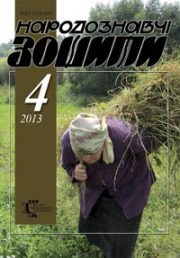

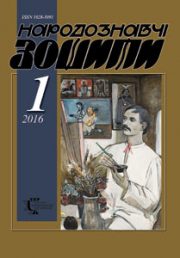
About magazine
The journal is included in the List of Ukrainian Academic Journals in which the results of dissertations for the degrees of Doctor of Science and PhD may be published. Approved by orders of the Ministry of Education and Science of Ukraine.
History – 032 (Order of the Ministry of Education and Science of Ukraine No. 157 dated February 9, 2021)
Philology – 035 (Order of the Ministry of Education and Science of Ukraine No. 1471 dated November 26, 2020)
Art History – 023 (Order of the Ministry of Education and Science of Ukraine No. 1471 dated November 26, 2020)
From 2025 – Cluster B: Humanities and Arts
The Editorial Board invites all those with scholarly achievements in various fields of contemporary humanities to collaborate.
Founders: National Academy of Sciences of Ukraine, Ethnology Institute of the NAS of Ukraine
Year of foundation: 1995
The publisher and producer of the journal of the Ethnology Institute of the NAS of Ukraine, in accordance with the order of the Presidium of the NAS of Ukraine dated March 24, 2022, No. 158 “On the Designation of the ‘Akademperiodyka’ Publishing House of the NAS of Ukraine as the publisher of scientific journals, the preparation and publication of which is carried out within the framework of the Program for the Support of NAS of Ukraine Journals,” is the “Akademperiodyka” Publishing House of the NAS of Ukraine
Media identifier: R30-02957
ISSN 1028-5091 (print)
ISSN 2786-6866 (Online)
DOI: https://doi.org/10.15407/nz
Frequency and circulation: 6 times a year.
The publication is indexed in scientometric databases:
V. I. Vernadsky National Library of Ukraine:
http://www.irbis-nbuv.gov.ua/cgi-bin/irbis_nbuv/cgiirbis_64.exe?Z21ID=&I21DBN= UJRN&P21DBN=UJRN&S21STN=1&S21REF= 10&S21FMT=juu_all&C21COM= S&S21CNR=20&S21P01=0&S21P02=0&S21P03= PREF=&S21COLORTERMS=0&S21STR=NaZo
Google Scholar
https://scholar.google.com/citations?user=bGkecisAAAAJ&hl=uk
ERIH PLUS
https://erihplus.hkdir.no/journal?id=498360
Purpose and Objectives
The aim of the academic journal “The Ethnology Notebooks” is to publish and disseminate the results of contemporary academic research in the fields of ethnology, folklore studies, art history, folk art, and related humanities disciplines, as well as to establish an academic platform for professional discussion of issues related to traditional culture, ethnic identity, and the sociocultural dynamics of the development of Ukrainian society and the international community.
Publication of original scholarly articles in ethnology, folklore studies, art history, cultural anthropology, and related disciplines.
Objectives:
to highlight issues related to traditional and contemporary culture, folk artistic practices, customary culture, and rituals;
to promote interdisciplinary research in the humanities;
to facilitate academic communication between Ukrainian and foreign researchers;
supporting the validation of research results by young scholars and graduate students.
Peer Review
Peer Review. All articles submitted to the journal’s editorial board undergo an independent peer review process. Reviewers are scholars conducting research in the relevant field. The quality of the research, originality, novelty, and structure of the article are evaluated.
After the initial selection, the manuscript is anonymized and sent for review to at least two independent experts — a member of the editorial board in the relevant scientific field and external reviewers (domestic or international specialists). Reviewers must not be affiliated with the authors or their institutions and must have no conflict of interest.
Neither the author nor the reviewers are provided with information about each other. The editorial board sends the submitted article (without the author’s name) to two selected reviewers who are experts in the field.
Manuscript review is conducted confidentially. Disclosure of the confidentiality of the manuscript review violates the author’s rights. Editors do not disclose information regarding the manuscript to anyone other than the authors and reviewers themselves. A breach of confidentiality is possible only in the event of a claim of inaccuracy or falsification of materials; in all other cases, confidentiality must be maintained.
Responsibility for copyright infringement and failure to comply with existing standards in the article’s content rests with the author. The author and reviewers are responsible for the accuracy of the facts and data presented, the validity of the conclusions and recommendations made, and the scientific and practical quality of the article.
Reviewers submit their reviews to the editorial board. Based on the evaluation results, the reviewer selects one of the following recommendations: accept the article for publication; accept after minor revisions; send for substantial revisions; reject. In the event of a negative decision or the need for revisions, the reviewer provides reasoned comments.
In the event of a negative review or the presence of substantial comments, the article may be rejected or returned to the author(s) for revision.
The editorial board makes the final decision on publication based on the reviewers’ conclusions. Reviews are retained by the editorial office for a specified period.
The final decision, along with the reviewers’ comments, is sent to the author.
Typical review times are 2–4 weeks, and the average time to the first decision is 4–8 weeks.
Open Access Policy
Archiving and Long-Term Preservation Policy
All publications receive Digital Object Identifiers (DOIs), which guarantee their unique identification and stable access.
The journal ensures the long-term preservation and permanent access to published content by implementing modern digital archiving procedures. To this end, the journal employs regular data backups, monitors its technological infrastructure to prevent information loss due to obsolete formats or software, and utilizes digital preservation metadata. Authors are encouraged to self-archive the published version of their articles in institutional repositories or on personal websites immediately upon publication.
Open Access Policy
The journal adheres to the Diamond Open Access model. This means that all research results become publicly available immediately upon the issue’s release without any financial, time, or technical barriers.
Publication Ethics and Editorial Policy
Publication Ethics and Editorial Policy
The editorial board of the journal adheres to international standards of publication ethics, in particular the recommendations of COPE (Committee on Publication Ethics), and is guided by the provisions of current Ukrainian legislation, including the Civil Code of Ukraine and the Law of Ukraine “On Copyright and Related Rights.” The policy is aimed at ensuring integrity, transparency, and accountability of all participants in the publication process.
Ethical Obligations of the Editorial Board
The editorial board is responsible for making decisions regarding the publication of scientific materials based on their scientific value, relevance, and alignment with the journal’s scope. All manuscripts undergo an initial screening and double-blind peer review. In the event of conflicting reviewer opinions, additional peer review may be requested. The editorial board reserves the right to reject a manuscript without sending it for review if it does not meet the requirements, is not relevant to the journal’s scope, or if ethical violations are detected.
Manuscripts are evaluated solely on the basis of their scientific content, without discrimination on any grounds. The editorial board guarantees the confidentiality of all materials and the protection of unpublished data.
Editors are required to recuse themselves from reviewing manuscripts in the event of a conflict of interest. The journal ensures transparency regarding the sources of research funding.
In the event of violations (plagiarism, data fabrication, or erroneous conclusions), the editorial board takes appropriate measures: publication of corrections, retractions, or withdrawal of the article.
The editorial board reviews all reports of ethical violations in accordance with COPE guidelines and takes necessary measures, including the publication of corrections or apologies if violations are confirmed.
Ethical Obligations of Authors
Authors are required to present accurate and objective research results with a sufficient description of the methodology to allow for their reproduction. Upon request by the editorial board, authors must provide raw data and ensure its preservation. Submitted works must be original. Plagiarism, self-plagiarism, falsification, or fabrication of data are unacceptable. A manuscript may not be submitted to multiple publications simultaneously.
Only individuals who have made a substantial contribution to the research are recognized as authors. All co-authors must approve the final version of the manuscript.
Authors are required to declare all potential conflicts of interest and sources of research funding.
If errors are discovered, authors must immediately notify the editorial board and assist in correcting them or retracting the article.
Authors are required to cooperate with the editorial board during the review process, respond to comments in a timely manner, and make necessary corrections.
Ethical Obligations of Reviewers
Peer review facilitates editorial decision-making and improves the quality of scientific publications.
A reviewer must accept for review only those manuscripts that fall within their scientific expertise and must promptly notify the editorial board if they are unable to complete the review.
Materials received for review are confidential and may not be used or distributed without the editorial board’s permission.
The evaluation must be impartial, well-reasoned, and based on scientific criteria. Personal criticism of the authors is unacceptable.
The reviewer must pay attention to the accuracy of citations, identify possible instances of plagiarism, duplication, or falsification, and report these to the editorial board.
A reviewer must not participate in the review of a manuscript if there is a conflict of interest and is obligated to inform the editorial board of this.
Compliance with the principles and recommendations of COPE, WAME, DORA, etc.
The editorial board of the journal adheres to the recommendations of leading international organizations in the field of academic integrity and open science, including COPE, WAME, DORA, ICMJE, and other contemporary initiatives.
1. COPE (Committee on Publication Ethics)
The journal adheres to the ethical standards defined by COPE:
Transparency — a clear and open process for submitting, reviewing, and publishing articles.
Impartiality — independence of editors’ and reviewers’ decisions.
Academic integrity — prevention of plagiarism, fabrication, and duplicate publication.
Proper authorship — clear definition of each author’s contribution.
Handling of complaints — open procedures for reviewing appeals and ethical complaints.
Corrections and retractions — a transparent procedure for retractions, corrections, and errata.
2. WAME (World Association of Medical Editors)
WAME guidelines are used to ensure high standards in scientific journals:
Editorial independence — editorial decisions are independent of sponsors, institutions, or commercial interests.
Conflicts of interest — authors, reviewers, and editors are required to disclose them.
Objective peer review — ensuring fair and timely expert evaluation.
Funding transparency — disclosure of grant and sponsorship sources.
Support for early-career researchers — promoting publications by researchers in the early stages of their careers.
3. DORA (San Francisco Declaration on Research Assessment)
The DORA principles aim to ensure fair evaluation of scientific activity:
Quality over quantitative metrics — evaluating research based on its scientific value, novelty, and contribution to science, rather than solely on bibliometric indicators (impact factor, h-index).
Recognition of diverse outputs — software, data, algorithms, and technical solutions.
Support for interdisciplinary research — equal standing with traditional publications.
Promotion of open science — publication of preprints, open access to data and code.
4. ICMJE (International Committee of Medical Journal Editors)
General principles include:
Authorship criteria — only those who have made a substantial contribution to the work are recognized as authors.
Research ethics — adherence to standards for working with data, human participants, and experiments.
Data openness — encouraging authors to preserve and provide access to research data.
5. OASPA (Open Access Scholarly Publishing Association)
The journal adheres to OASPA standards to ensure high-quality open access:
Publication quality — ensuring peer review, academic integrity, and the scientific value of the materials.
Transparency — open journal policies, including peer review, authorship, and funding.
Open access — publications are available free of charge and without commercial restrictions.
Ethical practices — preventing fraud, plagiarism, falsification, and conflicts of interest.
Promoting open science — encouraging the use of Creative Commons licenses, data archiving, and ensuring the long-term availability of research results.
6. Other contemporary principles and initiatives
Open Access — promoting open access to scientific results.
FAIR principles for data (Findable, Accessible, Interoperable, Reusable) — ensuring the discoverability, accessibility, interoperability, and reusability of data.
Plan S — supporting publication in open-access journals and repositories.
Ethical use of AI — transparency and accountability in the application of artificial intelligence in research.
AI and AI-Enabled Technologies Use Policy
In light of the rapid development of generative artificial intelligence (AI) and its increasing use in scientific research, the editorial board is implementing this policy to ensure transparency, reliability, and high quality in scientific publications. This document outlines guidelines for the use of AI tools by authors, reviewers, and editors. This policy applies to the use of AI in the preparation and evaluation of manuscripts and does not restrict its use as a research tool (data analysis, modeling, etc.), provided there is proper scientific justification. The editorial board reserves the right to review and update these provisions in accordance with technological developments.
For Authors. The use of generative AI tools in the manuscript writing process is permitted solely for the purpose of improving the linguistic quality of the text (readability, grammar, style). All results obtained using AI must be thoroughly checked and edited by the authors, as such tools may generate inaccurate, incomplete, or biased information. Authors bear full responsibility for the content, accuracy, and originality of the submitted materials.
The use of AI must be disclosed in the manuscript, specifying the name of the tool and the nature of its application. AI tools cannot be listed as authors or co-authors of the work, as authorship implies responsibility that can belong exclusively to a human.
The use of generative AI to create or substantially modify images, drawings, and illustrations is not permitted. Only basic technical processing (e.g., brightness or contrast correction) that does not alter the scientific content of the image is allowed. Exceptions are made when the use of AI is part of the research methodology; in such cases, it must be described in detail, specifying the tool, version, and method of use. Upon request by the editorial board, authors must provide source data or unprocessed images. The use of AI to create graphical annotations is prohibited.
Violation of these requirements may result in the rejection or retraction of the article.
For reviewers. A manuscript submitted for review is a confidential document. Reviewers are prohibited from uploading manuscripts or parts thereof to any AI tools, as this may violate the authors’ rights and principles of confidentiality. This rule also applies to review texts.
Reviewing involves an independent expert assessment based on critical thinking and professional competence. The use of generative AI to prepare or generate the content of a review is not permitted. The reviewer bears full responsibility for the opinion provided.
For editors. Submitted manuscripts and all related communication are confidential. Editors are prohibited from using AI tools to process manuscripts, reviews, or editorial correspondence, as this may lead to a breach of confidentiality and authors’ rights.
Editorial decisions are the sole responsibility of the editor and must be based on expert judgment, not on automated systems. The use of AI to support the decision-making process regarding manuscripts is not permitted. In the event of a suspected violation of this policy by an author or reviewer, the editor is obligated to notify the editorial board for further review.
This policy aims to ensure integrity, transparency, and accountability in the use of modern technologies in scientific publications.
Procedure for Handling Complaints Regarding Violations of Academic Integrity and Publication Ethics
The editorial board of the journal adheres to the principles of academic integrity and international standards of publication ethics, in particular the recommendations of the Committee on Publication Ethics (COPE). The complaint review procedure applies to authors of manuscripts and published articles, reviewers, members of the editorial board, and other individuals involved in the publication process. Complaints may be submitted by authors, reviewers, readers, representatives of institutions, or any other interested parties and must be clear, substantiated, and contain sufficient facts or evidence of possible violations (including plagiarism, fabrication or falsification of data, improper authorship, duplicate submission, conflicts of interest, review violations, etc.). Complaints must be submitted in writing (electronically) and must include information about the complainant, a description of the violation, details regarding the relevant manuscript or publication, as well as supporting materials. Complaints submitted in an offensive, threatening, or defamatory manner will not be considered; in cases that fall outside the journal’s jurisdiction, the complainant will be provided with a corresponding, reasoned explanation.
Upon receipt of a complaint, the editorial board conducts a preliminary review. If there are grounds for a detailed review, the editor-in-chief forms a temporary commission comprising members of the editorial board and/or independent experts, adhering to the principles of impartiality and the absence of conflicts of interest. The commission has the right to request explanations and documents from all parties involved, engage specialists, use verification tools (including for plagiarism), and other analytical methods. The person against whom a complaint has been filed has the right to be informed of its content, to provide written explanations and additional materials, and to appeal the decision in accordance with established procedures; the complainant, in turn, has the right to receive information about the progress of the review and to provide additional evidence.
The final decision is made by the editorial board or the editor-in-chief based on the data collected. Depending on the nature of the violation, the following measures may be applied: publication of corrections or retractions, withdrawal of the article, refusal to publish, temporary restriction of the right to submit materials, or other appropriate actions.
In the event of serious violations, the materials may be forwarded to the relevant institutions or competent authorities. All decisions are documented, the parties are notified of the results, and the confidentiality and protection of personal data are guaranteed by the editorial board of the journal.
Complaints are sent to the editorial office’s email address ethnolog@gmail.com and are reviewed within 30 business days, with the possibility of extending this period depending on the complexity of the case.
All decisions are issued in writing, and the parties are notified of the results of the review.
EDITORIAL BOARD
Liudmyla Herus, Doctor of History Science, Senior Scholar, Head of the Folk Art Department at the Ethnology Institute of the National Academy of Sciences of Ukraine (Lviv, Ukraine) – Editor-in-Chief
ORCID ID http://orcid.org/ 0000-0002-5931-3816
Stepan Pavliuk, Doctor of Historical Sciences, Academician of the National Academy of Sciences of Ukraine, Professor, Director of the Ethnology Institute of the National Academy of Sciences of Ukraine, Deputy Editor-in-Chief
ORCID ID http://orcid.org/ 0000-0003-0975-8099
Nadiia Voitovych, Ph.D. (Candidate of Historical Sciences), Associate Professor, Acting Head of the Ukrainian History and Economic Theory Department at the Stepan Gzhytskyi Lviv National University of Veterinary Medicine and Biotechnology (Lviv, Ukraine)
ORCID ID http://orcid.org/ 0000-0001-6313-9585
Scopus ID: 58504398000
Anna Garatyk, Ph.D. (Candidate of Sciences), Adjunct Lecturer at the Department of Social and Cultural Contexts of Pedagogy, University of Wrocław (Poland)
ORCID ID http://orcid.org/ 0000-0003-1641-6871
Myroslava Hnatiuk, Ph.D. (Candidate of Philological Sciences), Associate Professor, Department of Ukrainian Language, Lviv Polytechnic National University (Lviv, Ukraine)
ORCID ID http://orcid.org/ 0000-0002-1663-7095
Scopus ID: 58190314100
Volodymyr Diakiv, Ph.D. (Candidate of Philological Sciences), Associate Professor of the Ukrainian Language Department at Lviv Polytechnic National University (Lviv, Ukraine), Senior Scholar at the Contemporary Ethnology Department of the Ethnology Institute of the National Academy of Sciences of Ukraine (Lviv, Ukraine)
ORCID ID http://orcid.org/ 0000-0002-9513-4364
Scopus ID: 57221646131
Halyna Ivashkiv, Doctor of Art Studies, Senior Scholar, Leading Scholar of the Folk Art Department at the Ethnology Institute of the National Academy of Sciences of Ukraine (Lviv, Ukraine)
ORCID ID http://orcid.org/ 0000-0003-2359-6735
Scopus ID: 57954263600
Janina Kaminska, Ph.D., Professor, Head of the Social and Cultural Contexts of Pedagogy Department at the University of Wroclaw (Poland)
ORCID ID http://orcid.org/ 0000-0002-4674-8669
Roksolana Kvasnytsia, Ph.D. (Candidate of Art Studies), Associate Professor in the Visual Design and Art Department at the Institute of Architecture and Design, Lviv Polytechnic National University (Lviv, Ukraine)
ORCID ID http://orcid.org/0000-0001-7488-672X
Olena Kozakevych, Ph.D. (Candidate of Art Studies), Assistant at the Ethnographic Museum in Krakow (Poland)
ORCID ID http://orcid.org/ 0000-0002-8742-4337
Oleksandr Kolomiychuk, Ph.D. (Candidate of Historical Sciences), Scholar at the “Ukrainian Ethnological Center” Department of the M. T. Rylsky Institute of Art Studies, Folklore, and Ethnology of the National Academy of Sciences of Ukraine (Kyiv, Ukraine)
ORCID ID http://orcid.org/ 000-0003-2865-2396
Scopus ID: 57209733760
Petro Kostiuchok, Ph.D. (Candidate of Historical Sciences), Professor of the Ethnology and Archaeology Department at Vasyl Stefanyk Carpathian National University (Ivano-Frankivsk, Ukraine)
ORCID ID http://orcid.org/ 0000-0003-4607-7065
Scopus ID: 59359257200
ResearcherID KWU-4392-2024
Oksana Lahoda, Doctor of Art Studies, Professor, Head of the Textile and Clothing Design Department at the Kharkiv State Academy of Design and Arts
ORCID ID http://orcid.org/ 0000-0003-1808-7119
Scopus ID: 57205248387
Oksana Lytvyn, Ph.D. (Candidate of Philological Sciences), Associate Professor, Head of the Ukrainian Language Department at Lviv Polytechnic National University (Lviv, Ukraine)
ORCID ID http://orcid.org/ 0000-0002-8549-5123
Scopus ID: 57815927600
Maria Maierchyk, Ph.D. (Candidate of Historical Sciences), Senior Scholar of the Social Anthropology Department at the Ethnology Institute of the National Academy of Sciences of Ukraine (Lviv, Ukraine)
ORCID ID http://orcid.org/ 0000-0002-7535-4319
Scopus ID: 57193459797
Iryna Mentynska, Ph.D. (Candidate of Philological Sciences), Senior Lecturer of the Ukrainian Language Department at Lviv Polytechnic National University (Lviv, Ukraine)
ORCID ID http://orcid.org/ 0000-0001-7939-0010
Scopus ID: 57815611200
Natalia Mekh, Doctor of Philological Sciences, Professor, Head of the Screen and Performing Arts and Cultural Studies Department at the M.T. Rylsky Institute of Art Studies, Folklore, and Ethnology of the National Academy of Sciences of Ukraine (Kyiv, Ukraine), Senior Scholar at the Ethnology Institute of the National Academy of Sciences of Ukraine (Lviv, Ukraine)
ORCID ID http://orcid.org/ 0000-0002-5846-505X
Scopus ID: 58560361200
Oksana Mykytiuk, Doctor of Philological Sciences, Associate Professor of the Ukrainian Language Department at Lviv Polytechnic National University (Lviv, Ukraine)
ORCID ID http://orcid.org/ 0000-0003-3922-4610
Romana Motyl, Ph.D. (Candidate of Art Studies), Senior Scholar, Associate Professor at the Visual Design and Art Department at Lviv Polytechnic National University (Lviv, Ukraine), Senior Scholar of the Folk Art Department at the Ethnology Institute of the National Academy of Sciences of Ukraine (Lviv, Ukraine)
ORCID ID http://orcid.org/ 0000-0001-6936-0328
Scopus ID: 57982509600
Maryna Nabok, Ph.D. (Candidate of Philological Sciences), Associate Professor of Journalism and Philology Department at Sumy State University (Суми, Україна)
ORCID ID http://orcid.org/ 0000-0001-9422-730X
Olena Nykorak, Doctor of Art Studies, Professor, Leading Scholar at the Folk Art Department at the Ethnology Institute of the National Academy of Sciences of Ukraine (Lviv, Ukraine)
ORCID ID http://orcid.org/ 0000-0003-0887-8929
Scopus ID: 58262321600
Jan Pohunek, Ph.D. (Candidate of Sciences), Head of the Ethnographic Department at the National Museum in Prague
ORCID ID http://orcid.org/ 0000-0002-8533-4282
Scopus ID: 57206774010
Serhii Seheda, Doctor of Historical Sciences, Associate Member of the National Academy of Sciences of Ukraine, Professor, Senior Scholar of Historical Ethnology Department at the Ethnology Institute of the National Academy of Sciences of Ukraine (Lviv, Ukraine)
ORCID ID http://orcid.org/ 0000-0001-6772-8387
Hanna Sokil, Doctor of Philological Sciences, Professor at the Ukrainian Folklore Studies Department at Ivan Franko Lviv National University (Lviv, Ukraine)
ORCID ID http://orcid.org/ 0000-0002-8352-2124
Maria Sonevytska, Ph.D. (Candidate of Sciences), Associate Professor of the Anthropology and Music Department at Bard College (USA)
ORCID ID http://orcid.org/ 0000-0001-7458-7199
Scopus ID: 55872089900
Halyna Stelmashchuk, Doctor of Art Studies, Academician of the National Academy of Art of Ukraine, Professor of the Design Department at Lesia Ukrainka Volyn National University
ORCID ID http://orcid.org/ 0000-0002-5607-4936
Yaroslav Taras, Doctor of Historical Sciences, Professor at the Architecture and Restoration Department at Lviv Polytechnic National University (Lviv, Ukraine), Head of the Contemporary Ethnology Department at the Ethnology Institute of the National Academy of Sciences of Ukraine (Lviv, Ukraine)
ORCID ID http://orcid.org/ 0000-0001-7241-9466
Scopus ID: 58601117400
Andrii Tarasenko, Ph.D. (Candidate of Art Studies), Associate Professor of the Theory and Methods of Decorative and Applied Arts and Graphic Design Department at South Ukrainian National Pedagogical University (Odesa, Ukraine)
ORCID ID http://orcid.org/ 0000-0003-2739-3046
Olena Fedorchuk, Doctor of Art Studies, Senior Scholar, Leading Scholar of the Historical Ethnology Department at the Ethnology Institute of the National Academy of Sciences of Ukraine (Lviv, Ukraine)
ORCID ID http://orcid.org/ 0000-0002-4724-3566
Scopus ID: 57216853528
Ivan Khoma, Doctor of Historical Sciences, Associate Professor, Head of the History, Museology, and Cultural Heritage Department at Lviv Polytechnic National University (Lviv, Ukraine)
ORCID ID http://orcid.org/ 0000-0003-4607-7065
Rostyslav Shmagalo, Doctor of Art Studies, Professor of the History and Theory of Art Department at Lviv National Academy of Arts (Lviv, Ukraine)
ORCID ID http://orcid.org/ 0000-0002-9853-8989
Roman Yatsiv, Doctor of Historical Sciences, Professor, Head of the Wooden Art Department at the Lviv National Academy of Arts (Lviv, Ukraine)
ORCID ID http://orcid.org/ 0000-0003-1509-5367