The Ethnology Notebooks. 2026. № 4 (190), 976—983
UDK 94:001]+39+008](477)”19/20″(092)
DOI https://doi.org/10.15407/nz2026.04.976
- Received: 02.07.2026
- Accepted: 09.07.2026
- Published: 23.09.2026
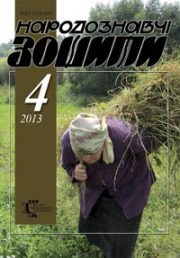
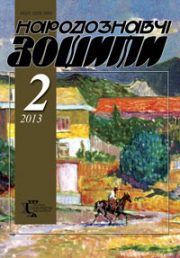
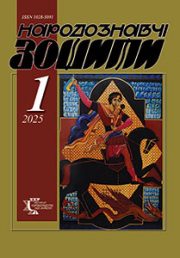
THE INSTITUTIONAL DIMENSION OF ROMAN YATSIV’S WORK: THE JOURNAL «NARODOZNAVCHI ZOSHYTY»
HERUS Lyudmyla
- ORCID ID: https://orcid.org/0000-0002-5931-3816
- Doctor of Sciences in History, Сandidate of Аrts(Ph. D),
- Head of Department, The Institute of Ethnology of the National Academy of Sciences of Ukraine, Department of Folk Art,
- 15, Svobody Avenue, 79000, Lviv, Ukraine,
- Contacts: e-mail: ludmilagerus@gmail.com
Abstract. The article comprehensively analyzes the institutional dimension of the activities of the prominent Ukrainian scholar, Doctor of Historical Sciences, Professor Roman Yatsiv in the context of the thirty-year development of the publication of the Institute of Ethnology of the NAS of Ukraine — the journal «The Ethnology Notebooks» («Narodoznavchi Zoshyty»).
The relevance of this topic is defined by the scholar’s 70th birthday anniversary, which offers an opportunity to re-examine his body of work and assess his contribution to the development of the humanities. The object of the study is Roman Yatsiv’s contribution to the development of domestic humanities discourse through his scholarly-organizational and editorial activities; the subject of the study is the process of the conceptual and structural-content development of the journal «Narodoznavchi Zoshyty» (Ethnological Notebooks), which has become a significant platform for presenting research in ethnology, history, art studies, cultural studies, folklore studies, and museology.
The research methodology is based on the principles of systematicity and objectivity, as well as on bibliographic and analytical methods.
The key role of Roman Yatsiv as the permanent executive secretary of the publication from the very beginning of its foundation is investigated. Special attention is paid to Roman Yatsiv’s own scientific legacy on the pages of the journal, where he recorded historical and cultural processes and modeled modern vectors of the humanities. It is substantiated that his publications contributed to the de-ideologization of the perception of many figures of national culture and the introduction of unknown sources into scientific circulation. The scholar’s systematic research of the activities of emigrant art associations of the 20th century (the «Spikyi» circle), as well as the work of Ukrainian emigrant artists (Hryhorii Kruk, Halyna Novakivska, Volodymyr Prokuda) and domestic figures (Vasyl Masiutyn, Yaroslav Skakun, Oleh Sydor) is analyzed.
Conclusions. Roman Yatsiv’s multifaceted work as a researcher, critic, and editor drove a transformation in the methodological parameters of domestic humanities scholarship. The scholar’s seminal works marked a conceptual shift from factographic description to a profound intellectual history of culture — viewed as an instrument of self-awareness and nation-building.
Keywords: Roman Yatsiv, «The Ethnology Notebooks», The Ethnology Institute of the NAS of Ukraine, culture, history, art, art of the Ukrainian diaspora, art history.
REFERENCES
- Yatsiv, R. (2000). «The Ethnology Notebooks»: five years of experience. The Ethnology Notebooks, 3, 385—389 [in Ukrainian].
- (1994). The Ethnology Notebooks. Monthly newspaper of the Institute of Ethnology of the National Academy of Sciences of Ukraine. Scientific and methodological rationale (project). Lviv [in Ukrainian].
- Official website of the journal «The Ethnology Notebooks». Retrieved from: https://nz.lviv.ua/ [in Ukrainian].
- Yatsiv, R. (2021). The «Vision of Homeland» as an ideological vector of activity of the ukrainian art group «Spokij» in Warsaw (1927—1939). The Ethnology Notebooks, 5 (161), 1096—1103. DOI: 10.15407/nz2021.05.1096 [in Ukrainian].
- Yatsiv, R. (2026). Hryhorij Kruk (1911—1988): contexts аnd horizons of creative thinking (in memory of Borys Voznytsky). The Ethnology Notebooks, 1 (187), 66—91. DOI: 10.15407/nz2026.01.066 [in Ukrainian].
- Yatsiv, R. (2025). Creative heritage of Halyna Novkivska: sensitivity in images and forms. The Ethnology Notebooks, 3 (183), 546—558. DOI: 10.15407/nz2025.03.546 [in Ukrainian].
- Yatsiv, R. (2025). Volodymyr Prokuda in post-apocalyptic transformations of creativity: Lontsky prison — Auschwitz concentration camp — New York. The Ethnology Notebooks, 2 (182), 317—326. DOI: 10.15407/nz2025.02.317 [in Ukrainian].
- Yatsiv, R. (2022). Vasyl Masyutyn and his creative reconstructions national history. The Ethnology Notebooks, 2 (164), 491—500. DOI: 10.15407/nz2022.02.491 [in Ukrainian].
- Yatsiv, R. (2022). History of Ukraine in names: sculptural images of Yaroslav Skakun. The Ethnology Notebooks, 1 (163), 226—235. DOI: 10.15407/nz2022.01.226 [in Ukrainian].
- Yatsiv, R. (2025). From romanticism to pragmatics professional tasks: origin of Oleg Sydor’s scientific thinking (on the occasion of his 80th birthday). The Ethnology Notebooks, 6 (186), 1139—1150. DOI: 10.15407/nz2025.06.1341 [in Ukrainian].